Finding the best GPS tracker for your car means choosing between two fundamentally different approaches: battery-powered passive trackers that last years without charging, and wired real-time trackers that update every few seconds but require installation and constant power. Neither is universally better — the right choice depends on what you actually need to track and why.
This guide breaks down five of the best car GPS trackers in 2026 across both categories, so you can match the technology to your situation.
The 5 Best GPS Trackers for Cars (2026)
- Piritiz — Best for no-wiring, long battery life
- LandAirSea 54 — Best compact real-time tracker
- Bouncie — Best OBD plug-in tracker
- Optimus 2.0 — Best budget real-time option
- BrickHouse Spark Nano — Best for hidden placement
1. Piritiz — Best Battery-Powered GPS Tracker for Cars
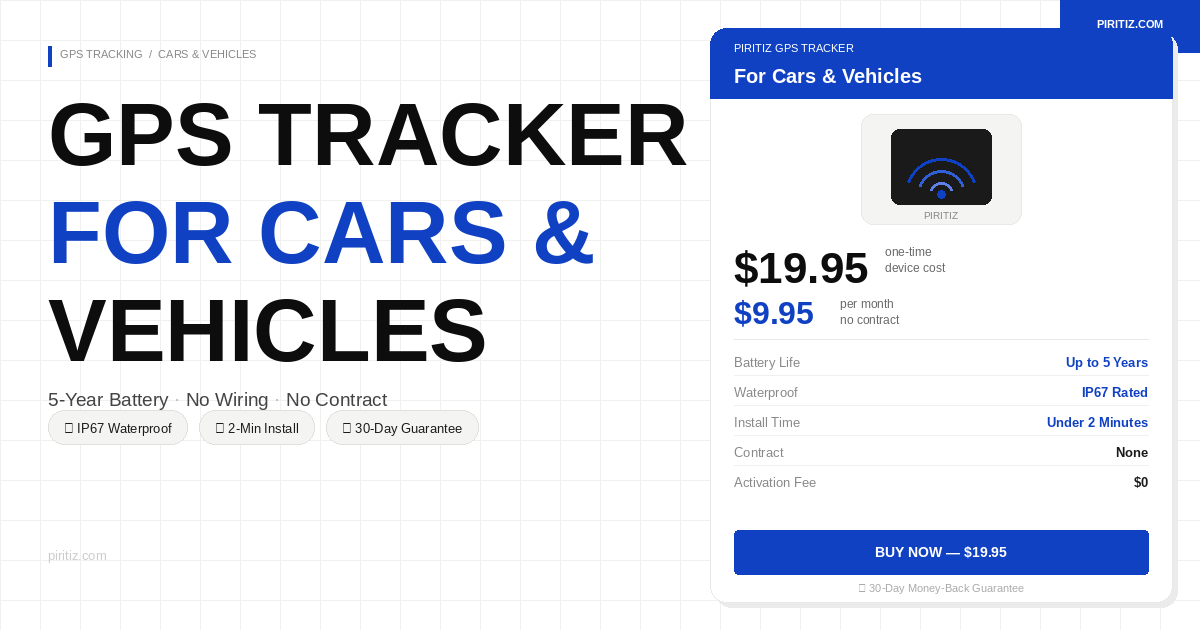
| Piritiz at a Glance | |
|---|---|
| Price | $19.95 device + $9.95/month |
| Battery life | Up to 5 years |
| Installation | None — magnetic mount, hides anywhere in under 2 minutes |
| Tracking type | Passive — movement-triggered location updates |
| Contract | None — cancel anytime |
| Waterproof | IP67 rated |
What makes it different: Piritiz is a passive GPS tracker, meaning it transmits location when movement is detected rather than continuously. This is what gives it the 5-year battery life — there’s no constant cellular ping draining the battery. For car owners who want to know if their vehicle moved, where it went, and where it is now, this provides everything needed without the wiring complexity of real-time systems.
Best for: Car owners who want theft protection and usage visibility without professional installation. Works well for tracking a vehicle left at an airport lot, monitoring a teenager’s car, or keeping tabs on a second vehicle. Since there’s no wiring, you can install it yourself in minutes and move it between vehicles freely.
Trade-off: If you need location updates every 10–30 seconds for active navigation or live pursuit of a stolen vehicle, Piritiz is not the right tool. The passive update model is designed for asset visibility, not real-time monitoring.
See the Piritiz GPS tracker for cars →
2. LandAirSea 54 — Best Compact Real-Time Tracker
| LandAirSea 54 at a Glance | |
|---|---|
| Price | ~$35–40 device + $24.95/month |
| Battery life | 2 weeks (requires recharging) |
| Installation | Self-install, magnetic mount |
| Tracking type | Real-time, updates every 3–30 seconds |
| Waterproof | IP67 rated |
What makes it different: One of the most popular real-time trackers on the market, the LandAirSea 54 offers frequent location updates through a companion app. It uses AT&T’s network and provides geofence alerts, speed alerts, and trip history.
Best for: Parents tracking a teenager’s driving, employers monitoring company vehicles with active drivers, or anyone who needs frequent location checks throughout the day. The relatively compact form factor fits in a vehicle’s OBD port area or can be magnetically mounted.
Trade-off: The 2-week battery life requires regular recharging — easy to forget. Monthly cost is roughly 2.5x Piritiz. Not suitable for long-term unattended placement on vehicles you don’t regularly access.
3. Bouncie — Best OBD Plug-In GPS Tracker
| Bouncie at a Glance | |
|---|---|
| Price | ~$67 device + $8/month |
| Battery life | Draws from vehicle OBD port (no separate battery) |
| Installation | Plug into OBD-II port (under dashboard, 30 seconds) |
| Tracking type | Real-time, updates every 60 seconds while vehicle is on |
| Works on | Cars/trucks with OBD-II port (1996+) |
What makes it different: Bouncie plugs directly into the OBD-II diagnostic port found under the dashboard of virtually every car built after 1996. No battery to worry about — it draws power from the vehicle. At $8/month, it’s one of the most affordable real-time options available.
Best for: Monitoring a family member’s driving habits, tracking a car you have regular access to, or fleet use on vehicles with OBD-II ports. The app shows trip history, driving behavior (hard braking, speeding), and current location.
Trade-off: Visible in the OBD port — anyone who knows what an OBD device looks like can spot it. Does not work on motorcycles, ATVs, older vehicles, or trailers. Goes offline when the vehicle’s ignition is off.
4. Optimus 2.0 — Best Budget Real-Time Option
| Optimus 2.0 at a Glance | |
|---|---|
| Price | ~$29 device + $19.95/month |
| Battery life | 1–2 weeks (requires recharging) |
| Installation | Self-install, magnetic mount |
| Tracking type | Real-time, configurable update intervals |
| Waterproof | Water-resistant |
What makes it different: A longtime value player in the GPS tracker market, Optimus 2.0 offers configurable update intervals — set it to update every 10 seconds for active tracking or extend to 5-minute intervals to save battery. Geofence alerts, SOS button, and basic trip history are included.
Best for: Users who want real-time capability at a lower entry price point. Good for occasional vehicle monitoring rather than 24/7 fleet-grade use. The configurable update frequency gives some control over battery drain.
Trade-off: Shorter battery life than advertised in real-world use when update frequency is high. Monthly cost is higher than competitors with similar feature sets. App interface is functional but dated.
5. BrickHouse Security Spark Nano 7 — Best for Discreet Placement
| BrickHouse Spark Nano 7 at a Glance | |
|---|---|
| Price | ~$99 device + $24.99/month |
| Battery life | 2 weeks at standard intervals |
| Installation | Self-install, very small form factor |
| Tracking type | Real-time, 30-second to 5-minute update intervals |
| Waterproof | IP66 rated |
What makes it different: One of the smallest real-time trackers available — roughly the size of a USB thumb drive. Designed for discreet placement inside vehicles where larger trackers would be conspicuous. BrickHouse includes a strong magnet and offers hardwired connection as an option for permanent installation.
Best for: Situations where the tracker needs to stay hidden — recovery investigations, fleet monitoring without device tampering concerns, or tight spaces where a larger device won’t fit. Professional-grade build quality justifies the higher price point for critical use cases.
Trade-off: The highest price in this comparison, both upfront and monthly. Battery life is similar to other real-time options — requires regular recharging. Overkill for most standard vehicle monitoring needs.
How to Choose: The Right Tracker for Your Situation
| If you need… | Best choice | Why |
|---|---|---|
| No installation, years of battery life | Piritiz | 5-year battery, magnetic mount, no wiring |
| Lowest monthly cost | Bouncie | $8/month, OBD-II powered (no battery concern) |
| Frequent location updates while driving | LandAirSea 54 or Bouncie | Real-time updates every 30–60 seconds |
| Track a vehicle left unattended for weeks | Piritiz | Battery lasts years — no recharging required |
| Hidden placement, hardwire option | BrickHouse Spark Nano | Smallest form factor, professional-grade |
Frequently Asked Questions
What is the best GPS tracker for a car with no monthly fee?
Truly subscription-free GPS trackers exist (offline data loggers) but they don’t transmit location remotely — you have to physically retrieve the device and download the data. For remote tracking, all GPS trackers require a cellular data plan to relay location. Piritiz offers no-contract monthly service at $9.95/month with no minimum commitment — you can cancel anytime, which is the closest real-world alternative to “no monthly fee” for a functional remote tracker.
Can I put a GPS tracker on a car without the driver knowing?
On a vehicle you own, yes — it’s legal in most US states to track your own property. Tracking a vehicle you don’t own without the owner’s consent is illegal in most jurisdictions. If you’re a parent tracking a minor child’s vehicle, you own the car, so it’s generally permitted. Always verify your local laws, particularly if tracking an employee’s personal vehicle.
How long does a car GPS tracker battery last?
Battery life varies widely by tracker type. Real-time trackers that update continuously typically last 1–3 weeks before needing a recharge. Passive GPS trackers like Piritiz, which transmit only when movement is detected, can run for up to 5 years on a single battery. The difference comes down to how often the cellular radio transmits — continuous transmission drains batteries in days; movement-triggered transmission preserves them for years.
Where is the best place to hide a GPS tracker on a car?
Common placement locations include under the vehicle frame (if the tracker is weatherproof), inside the wheel well, beneath seats, inside the center console, or in the trunk area. The tracker needs clear sky access for GPS signal — placement inside thick metal enclosures degrades accuracy. Magnetic trackers like Piritiz attach to any flat metal surface in seconds without tools.
Do GPS trackers work when a car is parked and the engine is off?
OBD-II plug-in trackers (like Bouncie) stop transmitting when the ignition is off, since they draw power from the vehicle. Battery-powered trackers (like Piritiz and LandAirSea 54) continue operating regardless of vehicle state — they detect movement independently of the engine. For theft protection of a parked vehicle, a battery-powered tracker is essential.
For passive tracking across all asset types — cars, trailers, equipment, and more — see Piritiz GPS tracker for cars or explore the 5-year battery GPS tracker overview.