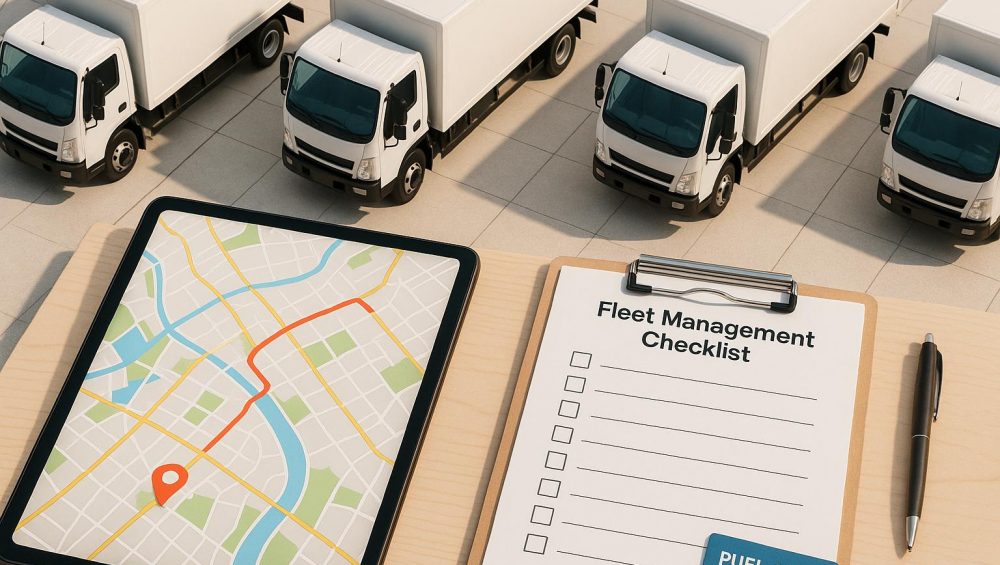
Managing a fleet can be complex, but following a structured checklist helps improve efficiency, reduce costs, and minimize downtime. Here’s a quick summary of the 10 steps covered in this guide:
- Set Up Fleet Management Policies: Establish clear guidelines for driver behavior, vehicle use, and compliance monitoring.
- Install GPS Tracking and Telematics: Use technology to track vehicle locations, monitor driving habits, and gather data to make informed decisions.
- Monitor and Reduce Fuel Consumption: Identify inefficient driving habits, optimize routes, and train drivers on fuel-saving techniques.
- Optimize Routes for Efficiency: Plan routes proactively and adjust them in real-time using traffic and weather data.
- Perform Regular Vehicle Maintenance: Create a maintenance schedule to prevent breakdowns and extend vehicle lifespan.
- Track and Analyze Key Performance Metrics: Focus on metrics like fuel efficiency, maintenance costs, and driver safety to spot inefficiencies.
- Improve Communication with Drivers: Use digital tools for real-time updates and feedback to ensure smooth operations.
- Conduct Regular Performance Reviews: Use data to evaluate and improve driver performance while gathering their feedback.
- Optimize Financial Performance: Track expenses, negotiate supplier agreements, and reduce costs across the board.
- Continuously Evaluate and Improve Your Fleet Strategy: Regularly review operations, set measurable goals, and adopt new technologies.
Fleet Management – How to Improve Transport Fleet Efficiency
Step 1: Set Up Fleet Management Policies
Clear, written policies are the backbone of a well-run fleet. They set the standard for driver behavior, ensure vehicles are used properly, and help avoid compliance headaches. Without these guidelines, there’s room for misinterpretation, misuse, and mistakes that could lead to bigger problems.
Think of fleet policies as your operational playbook. They define responsibilities, outline how vehicles should be handled, and clarify what happens when things go wrong. These rules help prevent accidents, minimize wear and tear on vehicles, and keep operations running smoothly.
Here’s how to establish and enforce these policies effectively.
Define Driver Responsibilities and Expectations
Drivers are the heart of your fleet, so it’s essential they understand their responsibilities. Start by covering the basics: licensing. Every driver must hold a valid license for the type of vehicle they operate, including any required endorsements, and maintain a clean Motor Vehicle Record (MVR).
Next, outline medical and compliance requirements. Drivers must complete DOT physical exams and participate in drug and alcohol testing programs, whether it’s pre-employment, random testing, or post-accident screenings. They’re also responsible for submitting all the necessary documentation for their Driver Qualification Files.
Your policies should also address on-the-road behavior. Drivers must follow traffic laws and local regulations, practice defensive driving, avoid distractions like cell phones, and recognize the signs of fatigue before it becomes a safety risk. Emphasize the importance of Hours of Service (HOS) compliance, requiring drivers to log their duty status accurately using electronic logging devices (ELDs). Falsifying records not only violates regulations but also compromises safety.
Vehicle care is another critical area. Drivers should conduct daily pre-use inspections, checking tires, brakes, lights, fluid levels, and other essential systems. They must review the previous Driver Vehicle Inspection Report (DVIR), note any unresolved issues, and sign off before starting their shift. At the end of the day, they should complete a new DVIR and immediately report any problems.
Fuel efficiency should also be part of the discussion. Encourage drivers to adopt fuel-saving habits like smooth acceleration, steady speeds, and avoiding unnecessary idling. These small changes can lead to noticeable savings over time.
Create a System for Monitoring Policy Compliance
Even the best policies are meaningless if no one is checking to see if they’re followed. A solid monitoring system ensures compliance without creating unnecessary red tape.
Start with regular inspections. Review DVIRs consistently to ensure they’re being completed correctly. Look for patterns – are certain drivers skipping steps? Are reported issues being ignored? Identifying these trends can help you spot gaps in your process.
Incident reports are another essential tool. Document every accident, near-miss, or case of vehicle damage. Record who was driving, the circumstances, and whether policies were followed. This isn’t about assigning blame – it’s about identifying areas where training or clarification might be needed.
Conduct performance reviews regularly, not just when issues arise. Go over each driver’s MVR, HOS compliance records, fuel efficiency data, and inspection completion rates. Use these reviews as an opportunity for face-to-face discussions to address concerns, recognize good performance, and give drivers a chance to share their perspectives.
Technology can simplify monitoring. Telematics systems can track driving behaviors like harsh braking or speeding. ELDs automatically log HOS data, reducing errors and violations. GPS tracking can confirm whether drivers are sticking to assigned routes or making unauthorized stops. These tools don’t replace human oversight, but they make the process more efficient and data-driven.
Documentation is crucial. Keep detailed records of policy violations, corrective actions, and follow-ups. If a driver repeatedly ignores the rules, having a paper trail will be essential. On the flip side, thorough documentation can also protect drivers who are following the rules by clearing up misunderstandings during incidents.
Finally, make sure there’s a feedback loop. If you notice compliance issues, talk to your drivers. Find out why the policies aren’t being followed – are they unclear, outdated, or impractical? Use this feedback to refine and improve your policies. The goal isn’t just enforcement; it’s creating a system that works for everyone.
With a solid foundation of policies and a system to monitor them, you’ll be ready to explore how technology can take your fleet management to the next level.
Step 2: Install GPS Tracking and Telematics
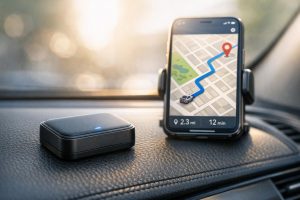
Once your fleet policies are established, the next step is equipping your vehicles with GPS tracking and telematics. These tools transform your fleet’s operations into actionable data. You’ll gain real-time insights into vehicle locations, driving habits, and emerging issues – helping you address problems before they escalate into costly repairs or safety risks. Paired with clear policies, this technology ensures you can enforce standards effectively.
Done right, these systems can quickly pay for themselves by cutting fuel costs, reducing maintenance expenses, and improving how your assets are utilized.
Select the Right GPS Tracking Solution
When choosing a GPS tracking system, reliability and practicality are key. The device should withstand real-world conditions like rain, snow, extreme heat, and freezing temperatures, all while being simple to install and maintain.
For ease of use, opt for battery-powered and wireless devices. Unlike hardwired systems, which often require professional installation and add to upfront costs, battery-powered trackers can be installed in minutes by anyone on your team. Just make sure the battery life is long-lasting – ideally several years – so you’re not constantly replacing batteries or dealing with dead devices.
Another must-have feature is a waterproof design. Since trackers are often exposed to the elements or mounted in vulnerable areas, they need to endure harsh weather without failing. A device that breaks down after the first rainstorm isn’t worth the savings.
Equally important is the tracking platform itself. It should offer real-time updates, movement alerts, and geofencing capabilities. For example, you should receive instant notifications if a vehicle leaves a designated area. A user-friendly interface that’s accessible 24/7 ensures you can monitor your fleet anytime.
Pay attention to the cost structure as well. Some providers lock you into long-term contracts with hidden fees, while others offer flexible, month-to-month plans. For instance, Piritiz GPS devices provide a waterproof, wireless design with up to 5 years of battery life. Their pricing starts at $9.95/month with no contracts or activation fees, and prepaying for a longer term can lower the cost to $7/month. However, the month-to-month option gives you flexibility if your fleet size or needs change.
Finally, think about scalability. If you’re managing five vehicles today but expect to expand to 20 next year, ensure the system can grow with you without requiring a complete overhaul.
Once your GPS tracking is in place, the next step is to use the data to make informed decisions.
Use Telematics Data for Operational Insights
GPS tracking tells you where your vehicles are, but telematics goes deeper, revealing how they’re being used. It provides data on speed, acceleration, braking, idle time, and engine diagnostics. This level of detail helps you move beyond simply knowing a vehicle’s location – it allows you to assess how efficiently and safely it’s being operated.
One of the most valuable insights telematics offers is into driver behavior. By monitoring patterns like harsh braking, rapid acceleration, and excessive idling, you can address specific issues. Instead of vague feedback like "drive more carefully", you can provide fact-based input, such as, "I noticed 12 hard braking incidents during Tuesday’s route. Let’s discuss what happened and how to avoid it."
Telematics also helps you improve fuel efficiency. For example, it can identify drivers who idle excessively or routes that consistently lead to higher fuel consumption. You might find that a certain delivery route is less efficient during peak traffic hours, prompting you to adjust schedules. Even small changes can add up – cutting idle time by just 10 minutes per vehicle per day can save hundreds of gallons of fuel annually.
Another major benefit is vehicle health monitoring. Telematics systems can track engine hours, detect fault codes, and alert you to potential mechanical issues before they lead to breakdowns. If a vehicle’s check engine light comes on, you’ll know immediately – even if the driver doesn’t report it. You can pull diagnostic codes remotely to decide whether the vehicle needs immediate attention or can complete its route before being serviced.
By using telematics, you can transition from reactive to proactive fleet management. For example, if you have 20 vehicles and limited maintenance staff, telematics can help you prioritize which vehicles need attention first. Maybe one truck is showing elevated engine temperatures, while another is due for an oil change based on mileage. This approach allows you to schedule maintenance based on actual needs rather than arbitrary timelines.
Over time, you’ll establish a performance baseline for your fleet. You’ll know what’s normal for fuel consumption, maintenance schedules, and driver behavior. When something deviates from these benchmarks, you can investigate and address it before it becomes a bigger issue.
To get the most out of telematics, it’s important to review the data regularly. Set aside time each week to analyze trends, identify areas for improvement, and take action based on the insights you uncover.
Step 3: Monitor and Reduce Fuel Consumption
After leveraging GPS tracking and telematics for insights, the next step is to focus on cutting fuel consumption. Since fuel costs make up a large portion of fleet expenses, even small improvements in efficiency can lead to noticeable savings. GPS and telematics tools are invaluable for pinpointing drivers, routes, and habits that contribute to higher fuel use, allowing for targeted adjustments.
Spot Inefficient Driving Habits
Start by determining your fleet’s baseline fuel efficiency. Calculate the average miles per gallon (MPG) for each vehicle type under normal operating conditions, ensuring comparisons are made between similar vehicle types and tasks. If a specific vehicle shows significantly lower MPG than others, it could point to a mechanical issue or less efficient driving practices.
Telematics systems can help you track key factors that affect fuel use, such as:
- Excessive idling: Long idle times waste fuel unnecessarily, so monitor and address this behavior.
- Harsh acceleration or braking: Sudden speed changes burn more fuel. Use telematics to identify and correct these patterns.
- Speeding: High speeds reduce fuel efficiency. Encourage drivers to maintain steady speeds for better conservation.
- Inefficient routes: Roads with frequent stops or heavy traffic increase fuel consumption. Look for alternative routes to save on gas.
Teach Drivers Fuel-Saving Techniques
Once inefficiencies are identified, share data-driven feedback with your drivers. Offer practical advice, such as:
- Turning off engines during extended stops to avoid wasting fuel.
- Accelerating and braking smoothly to maintain better fuel efficiency.
- Using cruise control when possible to keep speeds consistent.
- Reducing unnecessary weight in vehicles to improve MPG.
Incorporate these tips into regular safety or performance meetings. Provide ongoing feedback and set realistic goals for gradual improvement. Over time, these changes not only cut fuel costs but also reduce wear and tear on vehicles and help minimize environmental impact.
Step 4: Optimize Routes for Efficiency
After addressing fuel consumption through driver behavior, the next step is to refine the routes themselves. Poorly planned routes lead to wasted time, extra mileage, and higher fuel expenses. Every additional mile adds up quickly. By leveraging real-time data and smart scheduling, you can cut down on travel time, reduce vehicle wear and tear, and keep customers happy with more reliable delivery windows. These insights help create precise and efficient delivery plans.
Use Real-Time Data for Route Adjustments
Even the best-planned routes can fall apart when real-world conditions come into play. Traffic jams, accidents, road construction, and weather changes can turn a smooth route into a costly detour. Real-time route optimization allows drivers to avoid these issues as they arise.
Modern GPS systems track current traffic and road conditions, giving dispatchers the ability to reroute vehicles instantly. For example, if a major highway is backed up, the system can suggest an alternate path that saves both time and fuel. This is especially valuable for time-sensitive deliveries.
Weather is another factor that can impact route efficiency. Heavy rain, snow, or ice can slow down travel significantly. By monitoring weather forecasts and current conditions, you can adjust routes to bypass hazardous areas or account for slower travel times. This not only improves safety but also helps maintain realistic schedules.
Mobile tracking tools also play a crucial role in making immediate route adjustments. With real-time visibility, dispatchers can see where every vehicle is at any given moment. This allows them to make informed decisions, such as directing the closest driver to an urgent customer request or finding the quickest, safest route to a destination.
Providing both dispatchers and drivers with up-to-date information is essential. Drivers equipped with mobile devices or in-vehicle systems can adjust their routes on the fly without constant back-and-forth communication. This reduces unnecessary radio chatter and lets drivers focus on navigating safely and efficiently.
While real-time adjustments are critical, proactive planning can also go a long way in reducing wasted mileage and delays.
Plan Efficient Delivery Schedules
Careful scheduling before drivers hit the road can eliminate unnecessary miles. The key is to group stops by location and arrange them in a logical sequence.
Start by mapping out all the day’s stops. Look for clusters of deliveries or service calls in the same area and assign them to the same driver. Consolidating stops in nearby neighborhoods into one trip – an approach called route density optimization – can significantly reduce overall mileage.
Take delivery time windows into account as well. Some customers may require deliveries at specific times, which can limit your routing flexibility. Start by scheduling these fixed-time stops, then fill in the remaining flexible stops along the most efficient route. This avoids scenarios where a driver has to crisscross the city unnecessarily, saving both time and fuel.
If you handle recurring routes, historical data can be a goldmine for fine-tuning your schedules. For instance, if certain stops consistently take longer than anticipated, adjust your time estimates to better reflect reality. Similarly, if specific roads or intersections are known for bottlenecks during certain hours, plan routes that avoid them during peak times.
When creating daily schedules, also consider vehicle capacity. Overloading a vehicle or planning routes without factoring in capacity can lead to mid-route returns, which waste time and fuel.
To make this process even easier, investing in GPS tracking systems can be a game-changer. For example, Piritiz offers subscription plans starting at $9.95 per month, making advanced GPS tracking affordable for fleets of any size. With the ability to view all your vehicles on a single map, identifying inefficiencies and optimizing schedules becomes much simpler. The savings in fuel costs and productivity often outweigh the initial investment.
Lastly, build in a little buffer time for unexpected delays. Overly tight schedules can create stress for drivers, leading to rushed and potentially unsafe driving. Adding a few extra minutes to each route gives drivers breathing room for minor setbacks, ensuring smoother operations and better service overall.
Step 5: Perform Regular Vehicle Maintenance
After optimizing routes, keeping vehicles in top shape is crucial for a reliable fleet. Skipping maintenance might save time in the short term, but it often leads to bigger problems down the road. A single breakdown can throw off schedules, upset customers, and leave drivers stranded.
Preventive maintenance helps you catch small issues early. For example, replacing brake pads is far cheaper than dealing with a full brake system failure. Routine upkeep extends the life of your vehicles, allowing you to get more miles out of them before replacements are necessary. Plus, well-maintained vehicles run more efficiently, use less fuel, produce fewer emissions, and break down less often. This not only boosts operational performance but also keeps drivers safer and happier.
Managing maintenance across a fleet can be tricky, especially when vehicles accumulate miles at different rates. But just like route planning, a consistent maintenance strategy is essential to keep your fleet running smoothly.
Create a Maintenance Checklist
A detailed checklist ensures no maintenance task is overlooked. Organize it by frequency and vehicle system to stay on top of what needs attention and when.
- Daily Visual Inspections:
Drivers should do quick checks before heading out, including:- Inspecting tire pressure, tread depth, and any visible damage.
- Testing all lights – headlights, brake lights, turn signals, and hazard lights.
- Checking for fluid leaks under the vehicle or around the engine.
- Verifying wiper blades and washer fluid levels.
- Pressing the brake pedal and testing the parking brake for responsiveness.
- Weekly Maintenance Tasks:
These involve slightly more detailed checks:- Checking engine oil levels and topping off if needed.
- Inspecting belts and hoses for cracks or loose connections.
- Cleaning battery terminals and ensuring they’re secure.
- Using a gauge to confirm proper tire inflation.
- Reviewing dashboard alerts or warning lights that appeared during the week.
- Monthly Inspections:
Go deeper with these tasks:- Rotating tires to ensure even wear and prolong their lifespan.
- Testing and topping off fluid levels, including power steering, transmission, and coolant.
- Inspecting the exhaust system for leaks or damage.
- Replacing dirty air filters.
- Examining the suspension for worn components that could affect safety or handling.
- Seasonal Maintenance:
Prepare for weather changes with these checks:- Before winter: Test antifreeze levels, check battery strength, inspect heating systems, and install winter tires if needed.
- Before summer: Test air conditioning, check coolant levels to prevent overheating, and inspect seals and weather stripping for heat-related wear.
For heavy-duty vehicles, maintenance often follows service levels like Class A, B, C, and D. These range from basic visual inspections (Class A) to more in-depth overhauls (Class D). Aligning your schedule with these categories ensures every vehicle gets the attention it requires.
A detailed checklist not only prevents unexpected breakdowns but also supports your fleet’s overall efficiency. While manually tracking these tasks can get overwhelming as your fleet grows, a structured approach helps streamline maintenance, reduce downtime, and keep operations running smoothly.
sbb-itb-4827db2
Step 6: Track and Analyze Key Performance Metrics
Once your maintenance routines are in place, the next step is to track key performance metrics. This allows you to spot inefficiencies and make targeted adjustments. By leveraging insights from telematics and GPS systems, you can identify problem areas, prioritize corrective actions, and refine operations. Focusing on metrics that matter most helps you determine which vehicles need immediate attention, which drivers could use additional coaching, and where cost-saving measures are possible – all while maintaining quality and efficiency. Regular monitoring ensures you catch potential issues early, preventing them from escalating into costly problems.
Establish Core Metrics for Fleet Performance
Start by pinpointing the metrics that have the biggest impact on your fleet’s performance and costs. Instead of drowning in data, focus on a handful of key indicators that provide a clear snapshot of your fleet’s health:
- Fuel Efficiency: Compare each vehicle’s fuel consumption against its manufacturer specifications. Large deviations could point to mechanical issues or inefficient driving habits.
- Maintenance Costs: Track repair and upkeep expenses on a per-vehicle basis. High cost-per-mile figures might signal it’s time to retire or replace a vehicle.
- Vehicle Utilization: Measure how often each vehicle is actively in use versus sitting idle. Low utilization could indicate scheduling problems or an oversized fleet.
- Driver Safety Metrics: Monitor behaviors like harsh braking, rapid acceleration, and speeding. These can highlight drivers in need of additional training or coaching.
- On-Time Delivery Rates: Use this as a measure of customer satisfaction and operational efficiency. Repeated delays might point to issues with route planning or scheduling.
- Idle Time: Excessive idling wastes fuel and wears down engines faster than necessary.
Tools like GPS trackers, such as Piritiz, simplify the process of gathering and analyzing these metrics. With features like 24/7 tracking via a mobile app, you can monitor vehicle locations, movement patterns, and receive instant alerts for unusual activity. The reporting tools help you identify trends without needing to crunch numbers manually. Plus, with subscription plans ranging from $7 to $9.95 per month per vehicle, the cost is relatively low compared to the potential savings.
By tracking these metrics daily, you can make informed decisions that steadily improve your fleet’s performance.
Use Data to Prioritize Daily Tasks
Metrics are only useful if they drive action. Once you’ve established a baseline, incorporate these insights into your daily and weekly planning. Start each week by reviewing your performance dashboard to pinpoint areas needing attention:
- Identify vehicles with poor fuel efficiency and determine if the issue stems from maintenance problems or driver behavior.
- Address maintenance alerts promptly to fix minor issues before they lead to costly breakdowns.
- Analyze scheduling data to spot recurring delays or bottlenecks that require adjustments.
Create a priority system based on how significantly an issue impacts overall performance. For example, a vehicle consuming more fuel than expected or a driver frequently exceeding speed limits should be addressed immediately. Meanwhile, less urgent matters can be scheduled for follow-up later.
Recognize and reward top performers as well. If certain drivers consistently demonstrate safe, fuel-efficient driving, highlight their achievements. Learning from their practices and celebrating their success can motivate the entire team.
Set up automated alerts for critical thresholds – such as spikes in fuel consumption, overdue maintenance, or repeated speeding violations. This allows you to focus on strategic planning while letting the system flag urgent issues for your attention.
Finally, review trends over time rather than reacting to isolated anomalies. Comparing data across months or quarters helps you spot meaningful patterns. Keep in mind that some metrics, like fuel efficiency, may vary seasonally. For instance, winter conditions might affect performance compared to other times of the year.
Turn these insights into specific, actionable steps with clear ownership and deadlines. Don’t stop at noting high fuel costs or rising maintenance expenses – outline the exact measures needed to investigate and resolve the problem. This structured, proactive approach ensures that small, consistent improvements add up to significant gains in efficiency and cost savings over time.
Step 7: Improve Communication with Drivers
Clear and timely communication is a cornerstone of efficient fleet operations. Instant updates help avoid confusion, missed deliveries, and unnecessary fuel consumption. When drivers receive precise instructions and actionable feedback, they can make better decisions on the road.
Today’s fleet management goes beyond occasional calls or end-of-day check-ins. Drivers need real-time updates about traffic, route changes, and policy reminders. Meanwhile, managers benefit from sharing performance insights in a way that avoids micromanagement. A well-thought-out communication strategy not only reduces mistakes but also ensures drivers feel supported and informed.
Let’s explore how digital tools can simplify communication and improve operational efficiency.
Use Digital Communication Tools
Relying on paper logs or radios is outdated and inefficient. Digital tools allow managers to instantly send critical updates, such as route changes, weather alerts, or customer requests, directly to drivers. Mobile apps make this process seamless, enabling drivers to confirm receipt, ask questions, or report issues in real time.
Take GPS tracking systems like Piritiz, for example. These systems often come with mobile app features that act as communication hubs. Beyond tracking vehicle locations, these apps deliver real-time alerts. If a customer changes their delivery window or unexpected traffic arises, managers can notify drivers immediately, cutting down on confusion and potential errors.
Another benefit of digital communication is the ability to keep a record of all exchanges. If there’s ever a dispute over instructions or updates, having a message history allows both management and drivers to clarify misunderstandings and ensure accountability.
To keep work communications organized, consider using a dedicated messaging platform. This separates work-related messages from personal ones, ensuring nothing important gets overlooked. Group messages can handle general announcements, while direct messages are ideal for individual coaching or specific instructions.
Digital communication also makes performance feedback more constructive. Managers can share telematics data and brief explanations through the app, giving drivers time to review and respond without the pressure of face-to-face discussions. This approach often reduces tension and encourages thoughtful dialogue.
For urgent updates, push notifications are ideal, but it’s important to limit non-critical alerts to avoid overwhelming drivers with unnecessary pings.
Finally, digital tools create a two-way communication channel. Drivers can report vehicle issues, request assistance, or suggest route improvements without waiting for scheduled check-ins. This immediate feedback loop helps resolve problems quickly and fosters a collaborative work environment.
These tools also support regular updates on safety and performance, which we’ll discuss next.
Provide Regular Safety and Efficiency Updates
Consistent safety and efficiency updates help keep drivers aligned with fleet goals. Regular meetings are a great way to share updates on safety protocols, operational changes, and performance metrics. These don’t have to be long – short, focused sessions can be just as effective.
Start meetings with safety tips tailored to current conditions. In winter, for instance, discuss safe driving on icy roads. In summer, focus on staying hydrated and inspecting vehicles in high heat. Addressing real-world challenges makes safety advice more relevant and actionable.
When discussing performance metrics, highlight positive trends rather than focusing on shortcomings. For instance, if fuel efficiency improves, celebrate the drivers who contributed to that success. If performance dips, frame it as an opportunity to identify and address challenges together, rather than singling anyone out.
Use these meetings to explain the reasoning behind new policies or procedures. For example, if stricter idle time limits are introduced, explain how idling increases fuel consumption and engine wear. Helping drivers understand the broader impact can motivate them to adjust their habits.
Encourage drivers to share their insights during these sessions. They’re often the first to notice inefficiencies or potential improvements. Providing a platform for their feedback shows that management values their expertise and fosters a team-oriented culture.
If your fleet operates across multiple shifts, rotate meeting times to ensure all drivers have access to important updates. You can also record key points and share them through your digital communication platform so everyone stays informed, regardless of their schedule.
Weekly performance summaries sent via email or a dedicated app can also be helpful. These summaries might include metrics like miles driven, fuel efficiency, safety scores, and on-time delivery rates. By focusing on trends rather than individual judgments, drivers can identify areas for improvement without feeling criticized.
Regular communication reinforces training initiatives, such as reminders after a defensive driving session, and builds transparency around company performance. When drivers see how their efforts contribute to successes – like higher delivery volumes or cost savings – they feel more invested in the company’s goals.
Consistency is key. When drivers know to expect updates at regular intervals, it builds trust and emphasizes that fleet performance is always a priority, not just an occasional focus.
Step 8: Conduct Regular Performance Reviews
Building on the earlier discussion about telematics and GPS tracking, regular performance reviews are where data meets dialogue. These reviews help pinpoint inefficiencies, recognize top performers, and address potential issues before they escalate.
The key is to balance hard data with driver input. While the numbers reveal what’s happening, drivers can shed light on why. This dynamic fosters accountability while giving drivers a clear understanding of their performance and areas for improvement.
Review Driver Performance Metrics
Start by diving into the data. Telematics systems track critical metrics like harsh braking, rapid acceleration, speeding, and idling time. Instead of focusing on one-off incidents, look for patterns over time. For instance, if a driver’s fuel efficiency has declined over the past month, examine the data closely. Are they taking longer routes? Idling more frequently? Driving during peak traffic hours? These details provide essential context.
Driver scorecards can simplify this process. Combine safety, efficiency, and reliability metrics into an easy-to-read format, such as a 1-10 scale or letter grades. These tools make it easier for drivers to grasp their performance without sifting through raw data. Scorecards also highlight areas for improvement while rewarding safe and efficient drivers. For example, a driver who consistently excels in safety but struggles with fuel efficiency can be coached on eco-driving techniques.
Safety should always remain a top priority. Review accident reports, near-miss incidents, and vehicle damage claims. For drivers with multiple incidents, schedule one-on-one discussions to understand the root cause. Are they rushing to meet tight deadlines? Could they benefit from additional defensive driving training?
When analyzing metrics, it’s important to avoid making drivers feel like they’re under constant surveillance. Use the data as a tool for constructive conversations. Focus on support and solutions rather than simply pointing out flaws.
Performance data can also uncover broader issues. If several drivers are struggling with excessive idling, for example, it might indicate a scheduling issue or unclear delivery instructions rather than individual behavior. Identifying these trends can lead to meaningful operational improvements.
Finally, celebrate the wins. If fleet-wide fuel efficiency improves after introducing eco-driving training, share the success with your team. Recognizing progress reinforces positive behaviors and keeps morale high.
Gather Feedback to Refine Fleet Operations
Numbers alone can’t tell the whole story. Drivers are on the front lines and often have valuable insights into what’s working and what isn’t. Ignoring their input means missing opportunities to enhance efficiency and morale.
Create open lines of communication where drivers feel comfortable sharing their thoughts. This could be through chat platforms, feedback portals, or regular check-ins. The format matters less than ensuring consistency and responsiveness.
During performance reviews, ask targeted questions. Are there routes that consistently create challenges? Are certain delivery locations difficult to access? Do they have the tools they need to perform their jobs effectively? These conversations often reveal practical issues that data might overlook.
Listening to drivers reduces turnover and boosts satisfaction. Replacing and training new drivers is expensive and time-consuming. Short surveys – five to seven questions max – can help monitor satisfaction levels. Focus on actionable topics like equipment quality, schedule fairness, and management support.
In September 2025, Shu-Ling Su, General Manager of Chi Sheng Transportation in Taiwan, emphasized the ongoing challenge of recruiting and training professional drivers. To address this, they introduced regular eco-driving training and preventive maintenance programs to keep their fleet in optimal condition.
Driver feedback is also crucial when introducing new tools or policies. Before rolling out a new GPS system or altering dispatch procedures, consult experienced drivers. They can often spot potential issues and suggest adjustments to make the transition smoother.
Feedback can also shape training programs. If multiple drivers struggle with tasks like securing loads or using new software, it signals a gap that targeted training can fill.
Remember, performance reviews should be two-way conversations, not one-sided lectures. Give drivers the chance to explain their performance or propose solutions. They might offer perspectives you hadn’t considered.
Act on the feedback you receive. If drivers see their input leading to tangible changes – like improved routes, better tools, or clearer policies – they’ll be more likely to share ideas in the future.
Of course, not all suggestions can be implemented immediately. Budget constraints or contractual obligations might delay certain improvements. Be upfront about these limitations, but also explain what steps you can take in the meantime.
Regular performance reviews, when paired with earlier steps like monitoring fuel consumption and route planning, create a well-rounded management strategy. By balancing data-driven insights with open dialogue, you can elevate your fleet’s performance beyond just meeting the basics.
Step 9: Optimize Financial Performance
Once you’ve fine-tuned operations with performance data and driver feedback, it’s time to zero in on the financial side of fleet management. Even the best routes and most reliable vehicles won’t deliver results if operating costs spiral out of control. Financial optimization is all about knowing exactly where your money is going so you can make smarter decisions about spending, saving, and investing. Breaking down your expenses is crucial for boosting overall efficiency.
Track and Compare Expenses
Fleet expenses can quickly get out of hand if they’re not closely monitored. Costs like fuel, maintenance, insurance, registration fees, parts, driver wages, and vehicle depreciation can pile up fast. Start by categorizing these expenses to pinpoint areas that may need attention. For instance, if repair costs are consistently high, it might make more sense to replace a vehicle rather than continue patching it up.
Fleet management software can help centralize all this data – covering assets, drivers, fuel, parts, and costs – while offering features like automated receipt tracking and diagnostic port monitoring. Research shows that using a comprehensive fleet management system can cut costs by up to 30% and improve efficiency by 40%. For a fleet of 50 vehicles, this could mean annual savings of over $100,000, with the system paying for itself in just 12–16 months.
When choosing fleet management software, focus on plans or modules that match your specific needs. Avoid paying for unnecessary features. Free trials and ROI calculators can give you a clearer picture of potential savings, and comparing the total cost of ownership – including hardware, software, implementation, support, and any additional fees – can help you sidestep hidden costs.
Fuel is often the biggest variable expense, with 52% of logistics professionals spending more than 20% of their monthly budget on it. Tracking fuel usage by vehicle, driver, and route can uncover inefficiencies worth addressing. Maintenance costs are another area to watch closely. For example, only 14% of small fleets (1–4 vehicles) use maintenance software, compared to 56% of larger fleets (50+ vehicles). Regular expense reviews – monthly for immediate issues and quarterly for long-term trends – can keep costs in check. Monitoring the total cost of ownership (TCO) for each vehicle, including purchase price, depreciation, fuel, maintenance, insurance, and other expenses, can inform decisions about when to replace older vehicles.
Once you’ve got a handle on your expenses, the next step is finding ways to cut costs through better supplier agreements.
Negotiate Better Supplier Agreements
With a clear understanding of your expenses, you’re in a strong position to negotiate better deals with suppliers. Start with your fuel providers – ask about fleet fuel cards or volume discounts. Even small savings per gallon can add up significantly across your entire fleet.
For parts and maintenance, consider multi-year contracts or cooperative purchasing agreements to secure better rates. Work directly with vendors to reduce purchasing costs and establish price guarantees to shield yourself from future price hikes. If you outsource maintenance, gather quotes from several providers to ensure you’re getting the best value.
Financial optimization isn’t a one-time task – it requires consistent attention. By combining operational improvements with careful financial management, you’ll create a fleet that runs smoothly and remains cost-effective for the long haul.
Step 10: Continuously Evaluate and Improve Your Fleet Strategy
Managing a fleet isn’t a "set-it-and-forget-it" situation. Fuel prices, regulations, technology, and customer needs are constantly shifting, and staying ahead means treating efficiency as a continuous process. The best fleet managers regularly analyze their operations and adjust strategies based on real-time data.
Think of your fleet strategy as a living document. It should be updated frequently using insights from tools like GPS tracking, telematics, and performance metrics. Without this ongoing evaluation, you risk missing opportunities to cut costs or enhance service quality.
Set Long-Term Goals for Fleet Efficiency
Establishing clear and measurable goals is key to improving fleet efficiency. Dive into data on fuel consumption, maintenance expenses, vehicle usage, driver performance, and customer feedback to identify trends and set targets.
Your goals should be specific and time-bound. For instance, instead of vaguely aiming to "reduce fuel costs", set a concrete goal such as cutting fuel consumption by 10% within six months by addressing issues like excessive idling and inefficient routes. Similarly, rather than broadly aiming to "improve vehicle uptime", define a clear target based on your fleet’s operational needs.
Breaking large goals into smaller, manageable milestones – like quarterly benchmarks – can help maintain focus and momentum. Involve your team in setting these goals to ensure they’re realistic and achievable. Visual dashboards that track key metrics can also keep everyone aligned and help you make timely adjustments.
Once your goals are in place, explore emerging technologies to take your fleet’s performance to the next level.
Adopt New Technologies and Practices
The fleet management industry is undergoing rapid change, with new technologies paving the way for greater efficiency. For example, electric vehicles (EVs) are becoming a viable option for many fleets, offering long-term savings despite higher upfront costs. Before diving in, consider running a pilot program to evaluate factors like daily mileage needs, charging infrastructure, and route compatibility.
Beyond EVs, digital tools are transforming how fleets operate. AI-powered systems for route optimization and predictive maintenance can analyze data like traffic patterns, weather conditions, and vehicle usage to create more efficient routes and schedule repairs proactively. These tools help reduce downtime and improve overall performance.
Other innovations, like AI-enabled dash cams, can monitor risky driving behaviors – such as harsh braking or rapid acceleration – and provide instant feedback to drivers, promoting safer habits. While fully autonomous fleets are still on the horizon, semi-autonomous features like adaptive cruise control and lane-keeping assistance are already enhancing safety and reducing driver fatigue.
You should also explore alternative fuels, such as compressed natural gas (CNG), propane, or biodiesel, depending on your fleet size, routes, and what’s readily available in your area.
Finally, staying ahead means keeping up with changing regulations. Whether it’s emissions standards, electronic logging devices, or driver hour rules, compliance is non-negotiable. Create a process for evaluating new technologies, gathering input from your team, and testing solutions on a small scale before rolling them out fleet-wide.
Conclusion
Managing a fleet efficiently isn’t just about checking off tasks – it’s about creating a well-thought-out system that covers every aspect of your operations. From setting clear policies and using GPS tracking to keeping an eye on fuel usage, fine-tuning routes, and staying ahead with vehicle maintenance, each step works together to improve productivity and cut costs.
Looking back at the 10-step checklist, it’s clear that each action contributes to a smoother, more cost-efficient operation. Start by addressing your most pressing challenges, and remember that fleet management is an ongoing effort rather than a one-time fix.
Modern tools like GPS and telematics make this process much easier by offering real-time insights. For instance, telematics can notify you when a vehicle requires maintenance, reducing the risk of unexpected breakdowns. Meanwhile, GPS tracking allows you to spot inefficient routes and adjust them in real-time, saving both time and fuel.
This checklist serves as a practical guide to tackle each area systematically. Use it to track your progress, measure outcomes, and make data-driven decisions to refine your approach.
As emphasized throughout this guide, staying proactive is crucial. Whether it’s adapting to business growth, complying with new regulations, or leveraging emerging technologies, the most successful fleets are those that continually assess and improve their strategies. By following these steps, you’ll be well-equipped to navigate the challenges ahead.
FAQs
How can telematics and GPS tracking help improve my fleet’s efficiency and safety?
Telematics and GPS tracking systems play a key role in boosting your fleet’s efficiency and safety. With real-time vehicle tracking, you can monitor your fleet’s movements, keep tabs on driver behavior, and fine-tune routes for better performance. The result? Lower fuel usage, faster deliveries, and fewer unnecessary miles on the road.
These tools also encourage safer driving habits by flagging risky actions like speeding or sudden braking, which can help cut down on accidents. Plus, by simplifying operations and improving maintenance schedules, telematics can reduce downtime and trim operational costs. The outcome is a fleet that’s not only more productive but also more budget-friendly.
What key metrics should I monitor to improve fleet efficiency and cut costs?
To get the most out of your fleet and keep costs in check, it’s essential to monitor key factors like vehicle status, maintenance schedules, fuel consumption, driver behavior, and operational expenses. These areas provide critical insights into how well your fleet is running and where improvements can be made.
By staying on top of these metrics, you can spot inefficiencies, avoid expensive repairs, and encourage safer driving practices. For instance, sticking to a regular maintenance schedule helps prevent unexpected breakdowns, while reviewing fuel consumption and driver habits can reveal ways to cut fuel costs and boost overall efficiency.
What are the best ways to implement and enforce fleet management policies to ensure compliance and encourage better driver behavior?
To put effective fleet management policies into action, start by defining your expectations clearly and communicating them to your drivers. A written policy document is a great way to do this. It should cover essential rules like safe driving practices, vehicle maintenance duties, and adherence to federal and state regulations. Keep the language straightforward and ensure every team member can easily access it.
Take advantage of technology like GPS tracking systems and telematics to monitor driver behavior. These tools provide real-time insights into actions like speeding, harsh braking, and idling. With this data, you can quickly address problem areas and guide drivers toward improvements. Recognizing and rewarding positive behaviors, such as maintaining a clean safety record, can further encourage adherence to policies.
Regular training is another key element. Host workshops or schedule one-on-one meetings to review performance metrics, offer constructive feedback, and tackle any concerns drivers may have. By combining clear policies, smart technology, and ongoing training, you can build a fleet culture that prioritizes accountability and continuous progress.