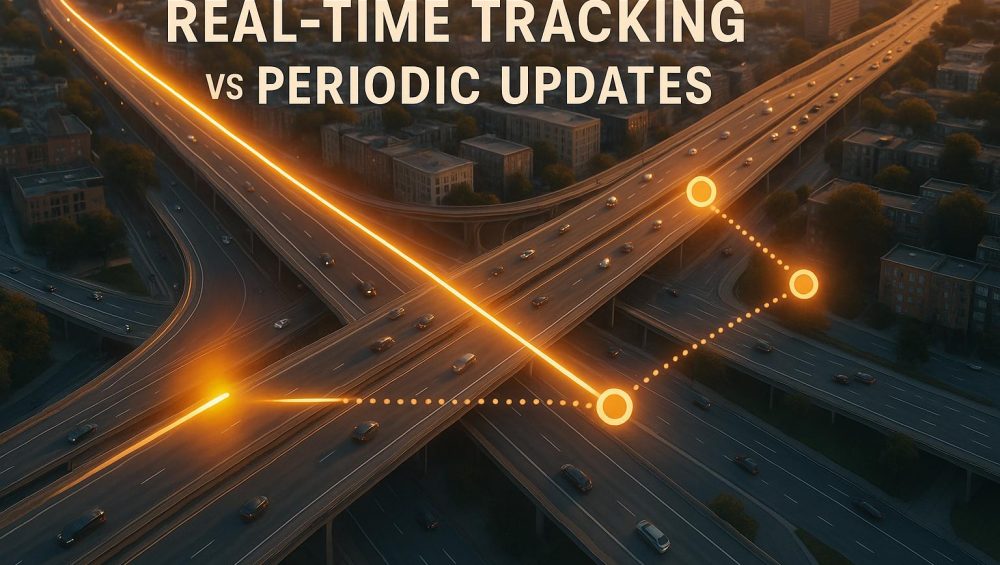
When managing fleets or equipment, choosing between real-time tracking and periodic updates comes down to how often you need location data and how it’s delivered. Real-time tracking provides continuous updates, ideal for time-sensitive operations, theft recovery, and monitoring driver behavior. Periodic updates, on the other hand, send data at scheduled intervals, making them cost-efficient and better for assets with predictable movements or limited power sources.
Key Takeaways:
- Real-Time Tracking: Offers live updates every few seconds to minutes. Best for immediate responses but higher costs and power usage.
- Periodic Updates: Sends data at set intervals (e.g., hourly or daily). Lower costs and longer battery life but lacks instant visibility.
Quick Comparison:
| Factor | Real-Time Tracking | Periodic Updates |
|---|---|---|
| Update Frequency | Every few seconds to minutes | Scheduled intervals (hourly, daily) |
| Power Consumption | Higher, requires constant power | Lower, longer battery life |
| Data Usage | High due to constant updates | Minimal, uses less data |
| Cost | Higher device and monthly fees | Lower overall costs |
| Best Use Case | Dynamic, high-value, or urgent assets | Stationary or predictable assets |
For fleets with diverse needs, a mixed approach – combining both tracking methods – can offer flexibility while keeping costs in check.
Real-World Testing of TrackerOne S20 and S20 Pro Live GPS Trackers!

How Real-Time Tracking Works
Real-time GPS tracking operates by continuously gathering and transmitting location data from a GPS device installed in vehicles or equipment. This device relies on GPS satellites to determine its exact location, accurate to within 10–15 feet. Once the position is identified, the device sends this data through a cellular network to a central server, where it’s processed and displayed on a dashboard or mobile app.
Updates are sent every few seconds to a minute, ensuring near-instant information. These data packets often include more than just location – they can also provide speed, direction, engine status, and even details like fuel levels or temperature readings.
To function, the system requires three key components: a GPS receiver, a cellular modem, and a power source (usually the vehicle’s battery or a rechargeable unit). What sets real-time tracking apart is its constant connection via cellular networks, which enables the steady flow of fresh data.
That said, this constant communication comes with trade-offs. Cellular data usage can range from 10–50 MB per month, and for battery-powered trackers, frequent updates can drain the battery quickly. For example, a tracker sending updates every 30 seconds might last only a few days, while one set to hourly updates could run for weeks on a single charge.
Network coverage is another critical factor. Real-time tracking depends on cellular signals, so gaps in coverage – like rural areas, tunnels, or regions with poor service – can interrupt updates. Many systems buffer the data during these lapses and upload it once the connection is restored, but this means you won’t see updates in real time during those gaps.
This continuous flow of data enables many features that are essential for effective fleet management.
Key Features of Real-Time Tracking
Real-time tracking provides live updates displayed on a map, offering immediate visibility into fleet locations. As vehicles move, their icons shift on the map, much like watching a navigation app track your own journey. This live view allows dispatchers to monitor vehicle positions in real time, enabling quick responses to changing situations.
Geofencing is another powerful tool. By setting virtual boundaries – such as around customer sites or warehouses – you can receive instant alerts when vehicles enter or leave these zones. This happens seamlessly because the tracker constantly compares its location to these predefined areas.
Event-triggered alerts go beyond simple location updates. Modern systems can notify you about specific occurrences such as harsh braking, rapid acceleration, excessive idling, unauthorized after-hours movement, or even tampering with the device. These alerts are typically sent via email, text, or push notifications within seconds.
Live breadcrumb trails provide a detailed history of a vehicle’s movements. By plotting each GPS point on the map, the system creates a visual record of the route taken. This level of precision is invaluable for verifying service calls, addressing customer complaints, or analyzing driver behavior.
Some systems also include two-way communication, allowing dispatchers to send messages or instructions directly to drivers. This feature supports dynamic routing and enables immediate responses to urgent situations, creating a complete communication loop.
Benefits and Drawbacks
Real-time tracking offers numerous advantages, particularly for businesses that require instant visibility into their fleet’s activities. For example, knowing the exact location of each vehicle allows for faster dispatching, reducing response times and fuel consumption. This is especially beneficial for service providers, delivery operations, and emergency response teams where time is critical.
Another major advantage is theft recovery. With real-time updates, you can monitor stolen vehicles or equipment as they move, providing law enforcement with precise location data to aid in recovery.
The system also helps improve safety by monitoring driver behavior in real time. Alerts for harsh braking, speeding, or other risky actions allow you to address issues immediately, fostering safer driving habits and reducing liability.
Real-time tracking further enhances customer service by providing accurate ETAs based on live vehicle locations and traffic conditions. Instead of vague arrival windows, you can give precise updates and proactively inform customers of delays, improving transparency and trust.
However, there are challenges to consider. Higher costs are a notable drawback, as real-time systems typically involve more expensive devices and higher monthly fees due to cellular data usage and server resources. On average, these systems can cost 30–50% more than periodic update alternatives.
Power consumption is another concern, particularly for devices not connected to a constant power source. Battery-powered trackers require frequent recharging or replacement, adding maintenance tasks and the risk of coverage gaps if the battery dies unexpectedly.
In areas with poor cellular coverage, data transmission issues can arise. Constant attempts to send data in these conditions can drain batteries faster and fail to deliver the real-time updates you’re paying for.
Some businesses may also encounter privacy concerns from drivers. Clear policies about how tracking data will – and won’t – be used are essential to maintaining trust and morale among employees.
Lastly, real-time tracking can lead to information overload if not managed properly. Without careful alert settings, the sheer volume of data can overwhelm dispatchers, particularly in larger fleets.
How Periodic Updates Work
Periodic GPS tracking collects location data at specific intervals, storing it until it’s ready to transmit. Essentially, it takes snapshots of a vehicle’s position at set times.
Here’s how it works: the GPS device determines its location using satellite signals. It then stores this data internally and waits until a scheduled time – like hourly, every few hours, or once a day – to transmit it. When the time comes, the device connects to a cellular network to upload the stored data to a central server. In areas where cellular coverage is spotty, some systems switch to satellite communication, though this can result in a slight delay of about two to three minutes after an event.
This "store-and-forward" method keeps the device in a low-power mode most of the time, activating the GPS receiver and modem only during scheduled updates. Many systems also use LPWANs (Low Power Wide Area Networks) to maximize energy efficiency. Some devices even offer incident-response tracking, sending immediate alerts when specific events occur. These technical advantages lead to several standout features.
Key Features of Periodic Updates
One standout feature of periodic tracking is its ability to significantly extend battery life. Since the device transmits data less often, battery-powered trackers can last much longer without needing frequent recharging or battery replacement.
Benefits and Drawbacks
While periodic tracking offers clear advantages, it also has its limitations.
On the plus side, this method is cost-efficient. Devices are less expensive, and the extended battery life reduces maintenance needs. However, the biggest downside is the delay between updates. Location data isn’t available in real time, which can be a problem if a vehicle moves unexpectedly. For instance, if a vehicle is relocated without warning, the system may not register the change until the next scheduled update. This delay can hinder immediate decision-making and slow down response times. Additionally, because the system records location data at intervals, the resulting information consists of discrete points rather than a continuous route, which may miss some details of an asset’s movements.
Real-Time Tracking vs Periodic Updates: Side-by-Side Comparison
Deciding between real-time tracking and periodic updates boils down to how each method aligns with your fleet’s operational priorities. Both have distinct advantages and trade-offs that can shape daily management practices.
Comparison Table: Key Factors
Here’s a breakdown of how these two tracking methods stack up across critical operational factors:
| Factor | Real-Time Tracking | Periodic Updates |
|---|---|---|
| Update Frequency | Provides updates every few seconds to minutes | Delivers updates at scheduled intervals (hourly, daily, or custom) |
| Battery Life | Needs a direct power source or frequent recharging | Designed for extended battery life |
| Data Usage | Consumes more data due to constant transmissions | Uses less data with intermittent updates |
| Installation | Requires integration with the vehicle’s power system or regular charging | Operates independently using internal batteries |
| Energy Efficiency | Higher power consumption from continuous streaming | Lower power consumption with periodic transmissions |
This comparison highlights key differences, particularly in power and data requirements, helping you weigh the options based on your fleet’s needs.
Which Method Fits Your Use Case
Your decision should reflect the specific demands of your fleet operations and the type of assets you manage.
Real-time tracking works best when immediate updates and rapid responses are critical. For instance, urban delivery fleets rely on constant location visibility, while emergency vehicles and high-value shipments benefit from continuous monitoring to address unexpected events instantly.
On the other hand, periodic updates are a practical choice for assets that don’t need constant oversight. Equipment at construction sites, trailers parked in storage, or vehicles on predictable routes can be monitored effectively with scheduled check-ins. A simple daily update can confirm an asset’s location while minimizing power usage and extending battery life.
For fleets with diverse needs, a hybrid approach can offer the best of both worlds. Assets can operate on periodic updates most of the time but switch to real-time tracking if unusual activity is detected.
Geographic factors also play a role. In areas with limited cellular coverage, periodic updates can store data locally and transmit it once connectivity improves, reducing the risk of blind spots.
sbb-itb-4827db2
How to Choose the Right Tracking Method for Your Fleet
Choosing the best tracking method for your fleet isn’t about chasing the latest tech – it’s about finding what works for how your fleet operates. The wrong choice can lead to unnecessary costs, while the right one can streamline operations and keep expenses in check.
Decision Framework
Start by considering what your assets do and where they go. High-value, mobile assets with unpredictable routes, like delivery vehicles in city traffic, shipping containers in transit, or sensitive equipment in high-risk areas, often need real-time tracking. While this option comes with higher power and data costs, the immediate visibility it provides can directly impact your bottom line.
On the other hand, stationary or low-risk assets – such as backup generators, construction equipment, or stored trailers – might only need periodic updates. A simple daily check-in confirms their location without draining batteries or racking up data charges unnecessarily.
Next, think about how quickly you need to respond. If your team needs to act within minutes – rerouting drivers, responding to theft, or dispatching roadside assistance – real-time tracking is essential. But if a once- or twice-daily location update is sufficient, periodic tracking can save battery life while still meeting your needs.
Power availability and connectivity also play a role. Vehicles with constant engine power can easily handle real-time tracking, but standalone trailers or portable equipment often perform better with periodic updates that preserve battery life for months or even years. If your assets operate in areas with unreliable cellular coverage, periodic tracking can store data locally and transmit it once the signal improves, ensuring you don’t lose valuable location information.
While budget constraints are important, don’t let them be your only guide. Look at the total cost of ownership, which includes hardware, subscription fees, installation, and maintenance. Real-time tracking may cost more upfront and monthly, but the operational benefits – like optimized routes that cut fuel costs or quicker theft recovery – can make it worth the investment for certain assets.
In many cases, the best solution is a mixed approach, combining different tracking methods to suit the unique needs of your fleet.
Using Both Methods Together
Tailoring your tracking approach to match your fleet’s specific needs can deliver the best results.
A mixed strategy works well for diverse fleets. For example, you might equip your active delivery vehicles with real-time trackers while using devices with periodic updates for backup vehicles, spare trailers, or equipment that doesn’t move often.
Some systems allow you to adjust update intervals, making it possible to switch between periodic and real-time tracking as needed. For instance, an asset might use periodic updates during routine operations but increase its reporting frequency if it enters a high-risk area or shows unusual activity. This flexibility ensures you’re not locked into one mode for each device.
Fleet managers can also set up conditional tracking rules to trigger real-time updates only when specific events occur. For example, a trailer might report its location every 12 hours while stationary but switch to frequent updates if it starts moving unexpectedly. This method balances security and battery life without requiring manual adjustments.
The key is to match each asset with the tracking method it truly needs, rather than applying a one-size-fits-all solution. By reviewing your fleet’s composition and identifying which assets require continuous monitoring, you can allocate tracking resources more effectively. This targeted approach helps you get the most out of your investment while ensuring critical assets remain secure and accounted for.
How Piritiz Supports Both Tracking Methods
Piritiz offers a solution that fits the needs of any fleet, seamlessly blending the benefits of real-time tracking with periodic updates.
Piritiz GPS devices are designed to handle both continuous real-time tracking and scheduled periodic updates. This dual capability ensures a balance between instant responsiveness and efficient reporting, giving fleet managers consistent oversight without compromise.
Piritiz Device Features
These GPS trackers are wireless, battery-powered, and incredibly easy to set up. With a waterproof design and a battery life that lasts up to 5 years, they’re built to withstand a variety of environments.
Installation is simple – just mount the device using the provided hardware and activate it through the mobile app. The app gives you 24/7 access to live map tracking and sends instant alerts for movement or when vehicles enter or leave designated areas. This means you’re always in the loop, no matter where your fleet is.
Adjustable Tracking Intervals
Piritiz devices let you customize how often tracking data is updated, all through the mobile app. Whether you need continuous real-time updates or prefer periodic reporting, you can adjust the frequency remotely without ever having to physically access the device.
Subscription Plans and Pricing
Piritiz offers flexible pricing to fit different budgets and needs. Plans start at just $7 per month per device with a 2-year commitment. For shorter terms, here’s how the pricing breaks down:
- 6-month plan: $9 per device per month (10% savings)
- 1-year plan: $8 per device per month (20% savings)
- 2-year plan: $7 per device per month (30% savings)
Month-to-month plans are also available at $9.95 per device. These options allow fleet managers to expand their tracking capabilities without worrying about surprise expenses.
Conclusion
Choose a tracking method that aligns with your fleet’s specific needs. Real-time tracking provides immediate updates, making it perfect for time-sensitive deliveries, emergency situations, or safeguarding high-value assets. However, it does come with higher data usage and costs. On the other hand, periodic updates are a more budget-friendly option for operations where constant monitoring isn’t essential, like overseeing equipment that stays in one location or vehicles with regular, predictable routes.
Different scenarios call for different approaches. For example, construction companies and delivery services might combine both methods – leveraging real-time tracking for valuable or dynamic assets while relying on periodic updates for assets that are stationary or follow consistent patterns.
FAQs
How do I decide between real-time tracking and periodic updates for my fleet?
When deciding between real-time tracking and periodic updates, it all boils down to what your operations demand. Think about how quickly you need information, how crucial instant decisions are, and the type of work your fleet handles.
Real-time tracking keeps you in the loop constantly, making it perfect for situations where quick action is a must – like sticking to tight delivery schedules or handling emergencies. Meanwhile, periodic updates deliver information at set intervals, offering a more budget-friendly option for operations that don’t require immediate data.
Take a close look at your priorities – whether it’s budget constraints, how fast you need to react, or the complexity of your fleet – to figure out which approach fits your needs best.
How does real-time tracking improve theft recovery and driver behavior monitoring compared to periodic updates?
Real-time tracking offers a game-changing advantage when it comes to theft recovery and monitoring driver behavior. By providing live location updates, it enables swift responses to unauthorized movements, greatly increasing the likelihood of recovering stolen assets quickly. Plus, immediate alerts allow fleet managers to tackle issues as they arise, minimizing potential risks.
On the other hand, relying on periodic updates can lead to delays and a lack of real-time awareness. With real-time tracking, decisions can be made faster and with greater precision, ensuring your assets are better protected and drivers remain accountable.
Can combining real-time tracking and periodic updates improve fleet management, and how can this approach work effectively?
Combining real-time tracking with periodic updates can bring a new level of flexibility and efficiency to fleet management. Each method serves a distinct purpose: real-time tracking is perfect for critical situations, like keeping tabs on high-value shipments or responding quickly to emergencies, where immediate updates are non-negotiable. Meanwhile, periodic updates work well for routine operations, helping to save battery life and cut down on data usage.
To make the most of this hybrid approach, you can adjust tracking settings to fit your fleet’s specific needs. For instance, activate real-time tracking for vehicles handling sensitive cargo or operating in risky areas. For less urgent tasks, stick with periodic updates. This way, you’ll stay informed when it counts while keeping costs and resources in check.